Here are our wonderful works of art for you to purchase for Calendar Art. Notices about this have been sent home today.
Thursday, 15 September 2016
Wednesday, 14 September 2016
Science - Little Garden
Yesterday we began our Little Garden Adventure. We are having a friendly (but serious) competition with Room 2 to see which class can get their seeds to germinate the fastest.
We have been given thirty seeds to grow. We were provided with the pots, the soil and the seeds. Our class has decided that we will use a bit of chicken poo - taken from under the roost and mixed with sawdust - and mix it with the soil we were given. Room 2 are using their worm vermicast and worm tea on their seeds.
We have discussed that in order to know if our chicken poo or worm poo made a difference, we need to keep everything else the same. We know the soil, seeds and pots are the same, so both classes have put their seeds in our school bottle house so that have the same growing conditions.
Part of our learning involved discussing what seeds needed to germinate. The children decided that seeds needed light, warmth, water, and soil. Our next step is to carry out some experiments where we take away one of each of the elements. We made some predictions about what will happen to the seeds without each element and we'll share this when we get the experiments up and running next term.
In the mean time here's some photos showing the process we went through to get our seeds planted.
![]() |
| Here William is braving the smell in the chicken coop and gathering our secret ingredient. |
![]() |
| These are the soil tablets - the video beside it shows what happens when you add water |
![]() |
| Mixing our secret chicken poo with the soil. |
![]() |
| Carefully putting the seeds and soil in. |
![]() |
| All planted and ready to start growing. |
Tuesday, 16 August 2016
Learning about BIG Numbers
Today we started by looking at the Olympic Medal Tally. We noticed that for a small country, New Zealand was doing really well.
We decided to look at the populations of the countries just below us, to work out if we were bigger or smaller than them. This prompted an interesting discussion as many children didn't know what population meant. Once we had that sorted, we went of in pairs to find out the population of a given country and the number of athletes in their team.
Once we had completed the table it became apparent that most of the class were struggling to read these very large numbers. This prompted an impromptu lesson on reading big numbers...
Using the Place Value Houses (as below) the children learned a story about a Trend Setter House with ones, tens and hundreds in it. The next house also has ones, tens and hundreds but is known as the Thousands house, after that comes the Millions house, etc. Each house can have up to 3 numbers in it. We looked at how big numbers have a gap or comma after every three numbers so it's easy to see how many 'houses' there are. This helps us read big numbers.
For example in the number 43 456 546 if I start on the left I can see the Trend Setter house, then the Thousands house and then the Millions house - this tells me my number is going to be in the millions.
After learning how to read the numbers we practiced by trying to read the populations of all the countries. By the end of the morning we were rattling off BIG numbers easily. You could try practicing with BIG numbers at home to see how much we remember!!!
Thursday, 11 August 2016
Our Beautiful Maunga
It was a beautiful day yesterday when we went out to practice cross country with our mountain standing proud.
Wednesday, 3 August 2016
Numbers in the Olympics
We've been having great fun this week exploring 'Numbers in the Olympics'. We've created a wall in our class where we put a sticky-note every time we find a new fact to do with numbers in the Olympics. Our wall was very bare on Monday, but by today, Wednesday, it's looking great and The Games haven't even started yet!
![]() |
| Wall of Numbers |
We worked in groups to find every one of the 206 countries competing in the Olympic Games, on our world map. We used google maps to find the distance from Rio to each of the countries and then placed a pin on the map to show where the country was.
| Using google maps to find the distance |
![]() |
| 206 pins on the map |
We had an interesting discussion about how a 'flat' map can make things different to a 'globe' because on a flat map some countries look like they are on the other side of the world to Rio but they are actually right beside them when you look at a globe.
We also found out that Usain Bolt holds the world record for the 100m sprint race with a time of 9.62 seconds. Some of the class thought they could probably run 100metres in that time, so we tried it out.....
Watch this space for more Olympic fun over the next couple of weeks!
Thursday, 7 July 2016
Mystery Skype
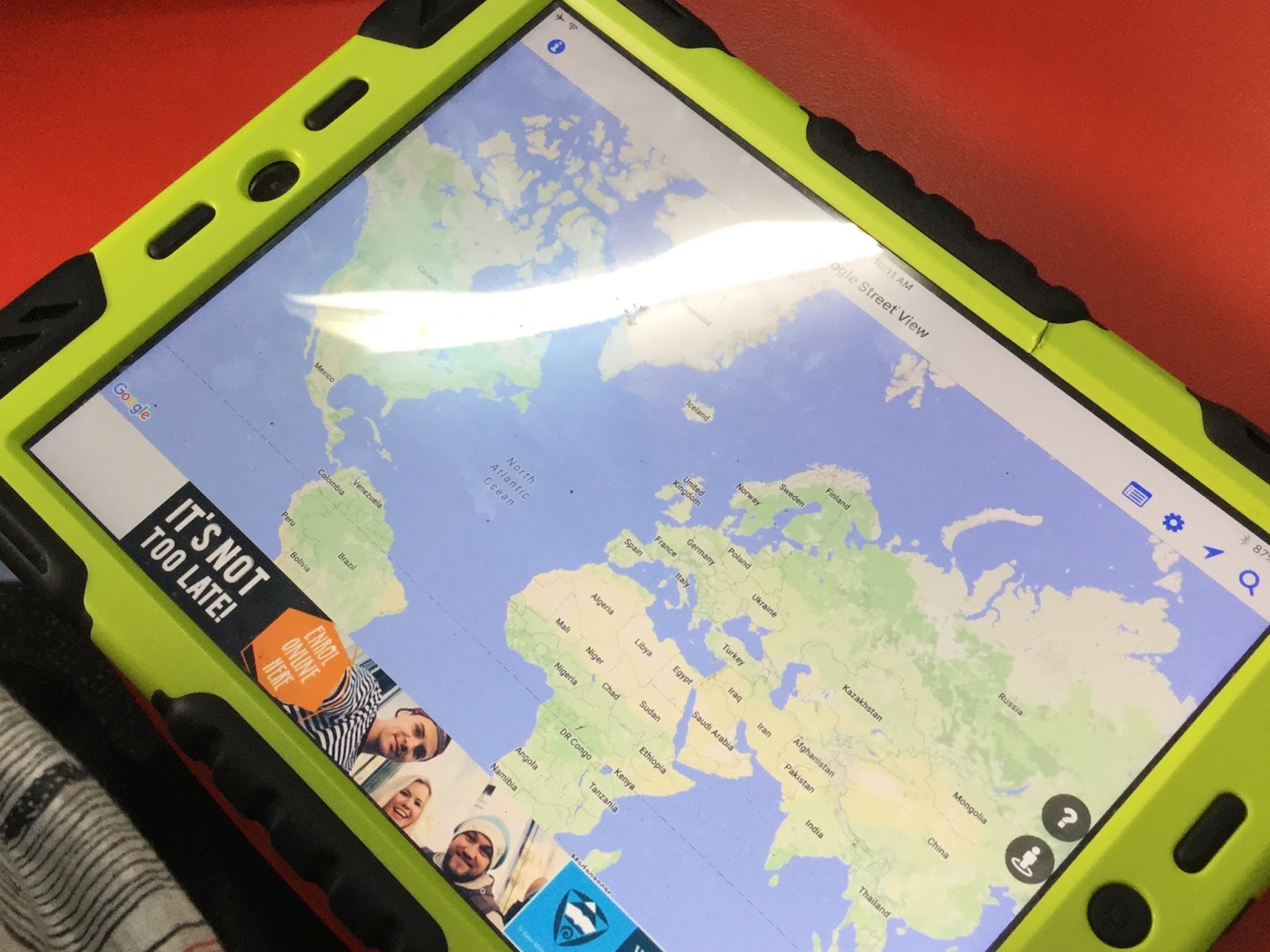
We had great fun today with our Mystery Skype Challenge. We were one of one hundred New Zealand schools who took part in the challenge. I signed the class up and we were matched up with another school. We had to Skype them and ask Yes or No questions to find out which island they were in, which region, which city/town/location and which school they were from.
The children all had roles - the directors had to keep the class quiet and on track, the ambassadors were the ones who spoke on behalf of our class, the detectives used our devices and google maps to try and figure out where they were, the cheerleaders ran questions between the detectives and the ambassadors and lastly the reporters took photos of everything as it happened.
We had to use team work, listening skills, mapping skills, computer skills, geography skills, questioning skills and many other skills during this challenge.
![]() |
| Some of our Detectives on the job |
![]() |
| Cheerleaders waiting to run questions from the Detective to the Ambassadors |
![]() |
| Using Google Maps to help us |
![]() |
| Sam and Kit were busy crossing off places that the Detectives had discounted |
![]() |
| Amy and Sierra were the Directors, keeping control for us |
![]() |
| Computer skills and map reading skills needed here |
![]() |
| Sharna and Slade were wonderful Ambassadors for our class |
![]() |
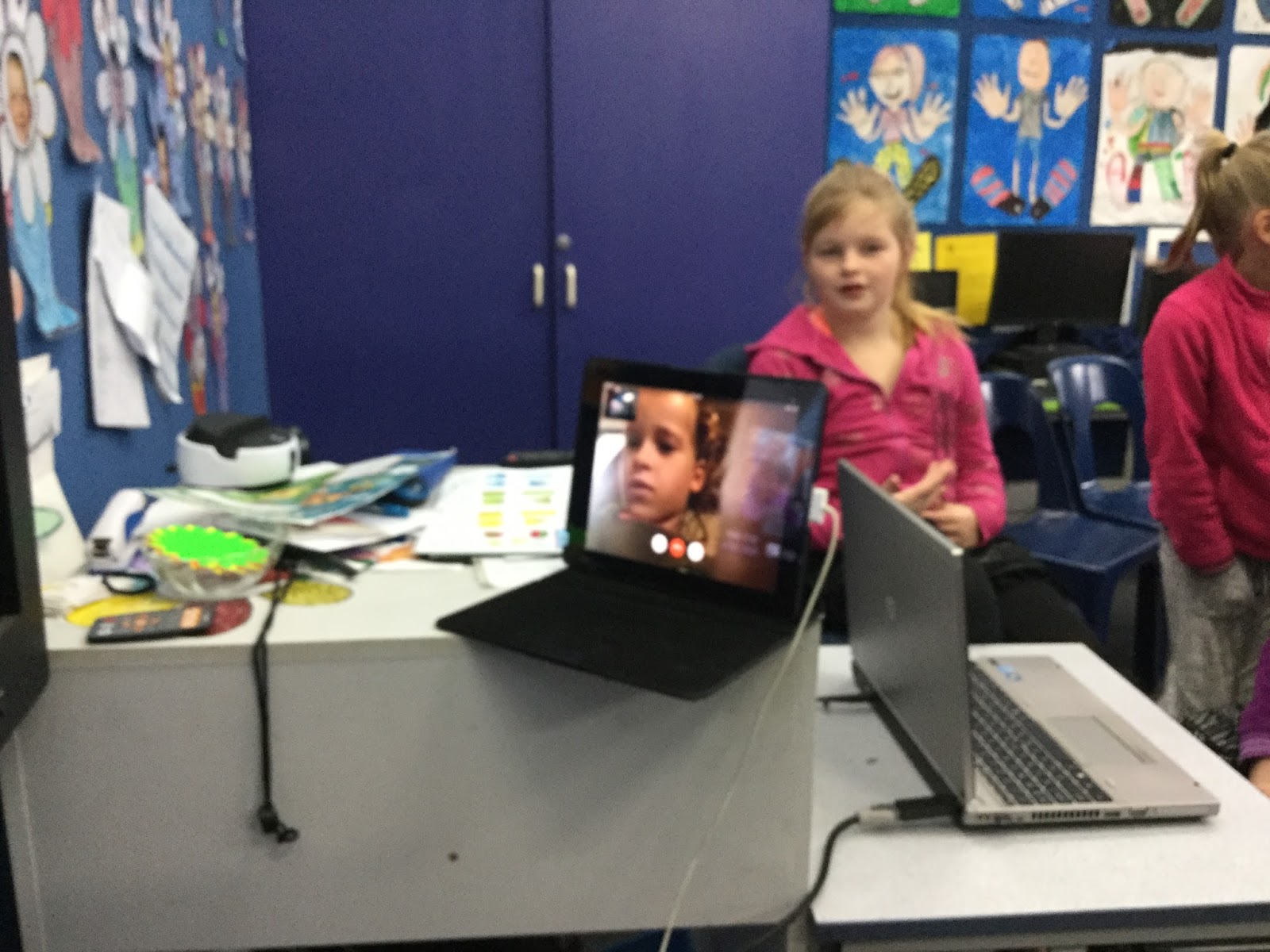
| Poor Pippa was at home sick, but didn't want to miss out so she Skyped in and watched from home |
![]() |
| The Ambassador from the other school. |
After about 40 minutes of great questioning from the other school they worked out that we were at Toko School. A couple of minutes later we discovered that they were from Peninsula Primary School in west Auckland. There were lots of similarities between the two schools - no uniform, enviro schools, etc and lots of differences too - city verses country school, we go to Year 8, they go to Year 6, they have 400 kids and we have 150 kids, etc. This whole challenge provided so much fun and such great learning. Everyone was fully involved, enjoyed the experience and learned many new skills - it's just what learning is all about.
Look out for more about what we've been up to this week on your child's blog.
Subscribe to:
Posts (Atom)